Service Robotics Market – Size, Growth, Structure

An economic overview of the global service robotics market based on internationally recognised reporting frameworks.

Editorial stance on market ranges and baselines

Service robotics is reported with widely different market figures because it is not a single accounting category. Analysts apply different classification boundaries, revenue models and inclusion criteria. As a result, no single number can credibly describe the market on its own.

This page therefore works with ranges, not absolutes. Ranges reflect what the literature supports across divergent scopes — from narrow hardware-only definitions to expanded ecosystem-based attribution. Both ends of that spectrum are known and acknowledged. The ranges presented here are not a compromise, but a reflection of methodological pluralism.
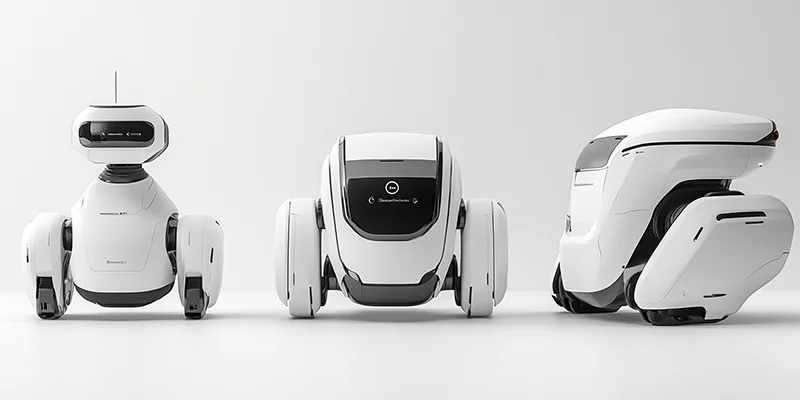
Robotic product line for domestic tasks

The curve shown below is a deliberately conservative midpoint. It represents a restrained baseline for professional service robotics, aligned with IFR-style classification logic, while consciously excluding broader, more expansive interpretations of the market.

This is a deliberate editorial decision. The intent is not to maximise reported volume, but to provide a stable reference point that reduces noise and enables consistent interpretation across time and sources.


Scope and Method

This page examines the global market for professional service robotics as defined by established international industry reporting frameworks.

It focuses on robotic systems deployed outside industrial manufacturing environments, operating in human-centred service contexts. Consumer robotics and industrial automation are considered only where boundary clarification is required.

Market figures in robotics vary widely depending on how the category is defined. For structural consistency, this page applies the application-based classification framework published by the International Federation of Robotics (IFR) ↗ in its World Robotics – Service Robots reporting.

The IFR framework is used strictly as a classification and segmentation reference. It defines the boundary of professional service robotics, but does not provide market size or revenue forecasts.

All economic values presented on this page are derived from independent market research sources and interpreted in alignment with IFR classifications for methodological clarity. Market figures therefore remain outside the authority scope of the IFR.

Transition from industrial robotics to service robotics

Global Service Robotics Market Growth (2025–2035)

2025 $8B
CAGR +16.9%
2035 $38B

Baseline interpretation: The curve represents a deliberately conservative growth baseline for professional service robotics. It reflects an informed midpoint across a wide range of published market estimates, chosen to prioritise interpretability and structural consistency over expansive attribution.


$40B $30B $20B $10B $0 2025: $8B 2027: $11B 2029: $15B 2031: $21B 2033: $28B 2035: $38B 2025 2027 2029 2031 2033 2035
  • 2025: Early scaling phase, predominantly logistics and cleaning deployments (~USD 8B).
  • 2030: Cross-sector normalisation as healthcare, hospitality and agriculture mature (~USD 18B).
  • 2035: Service robotics established as continuity-critical infrastructure (~USD 38B).

Detailed bibliographic references, publication years and source access information are documented on Sources →
No single study is reproduced verbatim.

Why Service Robotics Market Sizes Differ

Reported market sizes for service robotics vary substantially because analysts apply different classification boundaries and revenue attribution models. These methodological choices, rather than conflicting observations, explain most discrepancies.

Classification boundary

The International Federation of Robotics (IFR) applies a narrow, application-based definition of professional service robots, focused on deployment categories and unit-based reporting. The IFR does not publish market revenue forecasts.

Many market research providers use broader boundaries, extending the category to adjacent application areas and system classes such as medical robotics, humanoid platforms, software layers, service contracts and infrastructure-related revenue components.

Revenue attribution

Conservative estimates typically reflect hardware-only sales. Higher projections incorporate recurring software, service-based models and lifecycle-related revenue streams. These differences lead to structurally divergent market totals.

Reference example

As an illustration, Precedence Research reports a 2025 market size of USD 62.85 billion for service robotics and projects growth to USD 233.8 billion by 2035, based on an expanded interpretation of the category. Such figures are consistent within their stated scope, but are not directly comparable to narrower baselines.

For this reason, market values on this site are presented as contextual reference ranges. Individual figures are treated

Market Size and Long-Term Outlook

Published estimates for professional service robotics place the global market in the range of several tens of billions of US dollars in the mid-2020s. Absolute figures vary by source, primarily due to differences in category boundaries and revenue attribution.

Across divergent studies, however, long-term outlooks are directionally consistent. Most project sustained double-digit growth through the 2030s, with aggregate market volumes expanding well beyond current levels as service robotics becomes structurally embedded across sectors.

These growth trajectories align with unit-based deployment trends reported by the International Federation of Robotics, while revenue figures are sourced exclusively from independent market research and interpreted within that classification context.

Market expansion is therefore understood here as a structural development, driven by persistent service demand and operational constraints, rather than as a function of short-term technological cycles.

Robot care in retirement homes

Structural Drivers of Expansion

Growth in professional service robotics is not driven by episodic technology enthusiasm, but by persistent structural constraints across service-intensive sectors.

The primary driver is labour availability. In logistics, hospitality, healthcare and related service environments, staffing shortages and continuity requirements limit the scalability of human-only operations. Service robots are deployed where reliability over time matters more than marginal efficiency gains.

A second driver is demographic pressure. Ageing societies increase demand for care, support and assistance services, while simultaneously reducing the available workforce. Robotics adoption in these contexts reflects necessity, not experimentation.

Technological progress acts as an enabling condition rather than a root cause. Advances in sensing, navigation and autonomous control lower deployment thresholds, but adoption follows operational need, not novelty.

Together, these drivers explain why service robotics continues to expand even under broader economic uncertainty: deployment responds to structural imbalance, not to short-term market sentiment.

Regional Dynamics and Reporting Context

Service robotics deployment is global, but regional patterns reflect structural, economic and institutional conditions rather than differences in technological capability alone.

Reporting by the International Federation of Robotics (IFR) indicates the largest installed base of professional service robots in Asia, particularly across logistics, hospitality and medical services. This distribution corresponds to population density, large-scale service infrastructure and long-term automation investment.

Europe and North America show comparatively stable deployment across healthcare, inspection, infrastructure services and warehouse environments. In these regions, adoption is often shaped by labour availability, regulatory clarity and integration into established operational workflows rather than by deployment volume alone.

Robots as shopping advisors

China warrants specific contextual interpretation. It functions simultaneously as a large-scale deployment environment, a primary manufacturing base and an internally coordinated service robotics ecosystem. Deployment patterns in China are therefore influenced not only by labour economics, but also by industrial policy, urban infrastructure planning and state-aligned service modernisation strategies.

As a result, Chinese service robotics adoption cannot be fully interpreted through Western market logic alone. In international reporting, China is treated as an integral component of Asia-based statistics, but analytical comparability requires awareness of differing deployment drivers and institutional contexts.

Regional data on this page is presented descriptively. No rankings, percentage weightings or normative comparisons are inferred without explicit reporting. All references follow IFR terminology and segmentation to preserve international comparability without oversimplification.

Interpreting the Market

Market size figures describe volume, not relevance. In service robotics, economic magnitude alone does not explain why systems are deployed, maintained and scaled in real-world operations.

More indicative than headline growth rates is the breadth of adoption across structurally unrelated service environments and the transition from isolated pilots to sustained, fleet-level deployment. This shift marks the point at which service robots cease to be evaluated as experimental technology and are treated as operational assets.

An additional signal lies in procurement logic. The increasing prevalence of subscription-based and service-oriented deployment models reflects a move away from discrete capital expenditure toward continuous operational integration and lifecycle responsibility.

Taken together, these patterns indicate that service robotics is increasingly understood as continuity-critical infrastructure. Adoption persists across economic cycles not because of novelty or short-term efficiency gains, but because robotic systems address structural constraints in service delivery, labour availability and operational reliability.

The significance of the service robotics market therefore lies less in peak valuation scenarios than in its stabilising role within essential service environments over time.

Trust a robot

This interpretation is intended to support informed comparison, not to substitute primary market research.