Core Concepts

Professional Evaluation Criteria for Service Robots

How Service Robots Are Evaluated

Service robots are assessed based on a limited set of recurring criteria that apply across application contexts. These criteria do not describe products or use cases. They describe conditions for professional deployment. Across logistics, healthcare, hospitality and inspection, evaluation converges on three concepts.

This framework applies to professional service robots deployed in shared human environments and explicitly excludes consumer gadgets, experimental research platforms and entertainment robotics.

This evaluative framework is implicitly reflected in international standards, procurement guidelines and deployment assessments, independent of manufacturer, form factor or application domain.

Human–Robot Interaction (HRI)

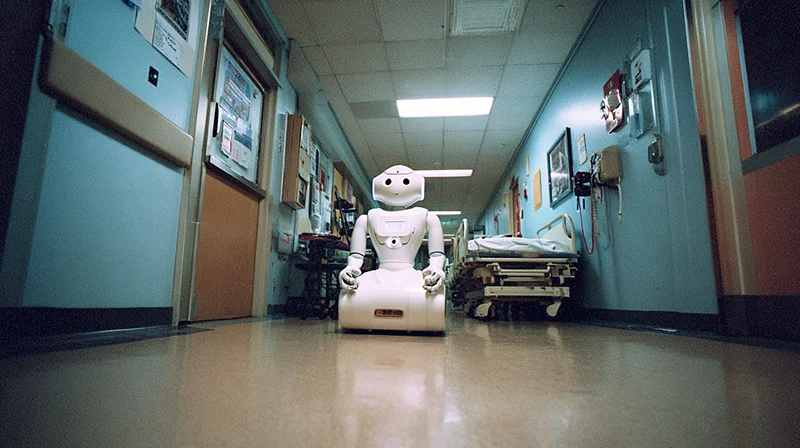
Human–robot interaction describes how a service robot behaves in the presence of people during operation. In professional environments, robots do not operate in isolation. They share space with humans, move in proximity to them and affect their behaviour. Evaluation therefore focuses on predictability rather than appearance.

Interaction quality is assessed by observing whether a robot’s actions can be anticipated, whether motion and signalling are readable, and whether the system responds appropriately to human presence.

Poor interaction design leads to hesitation, avoidance or rejection, even when task performance is technically adequate. For this reason, HRI is a decisive factor for acceptance in real-world deployment.

Human-robot interaction (HRI)

Autonomous Task Execution

Autonomous task execution refers to a service robot’s ability to perform defined tasks based on perception and internal decision-making without continuous human control.

Autonomy is not measured by maximal independence but by context-appropriate control. In many service environments, bounded autonomy is more effective than unconstrained behaviour.

Evaluation focuses on perception, localisation, navigation, task sequencing and recovery from unexpected states. Systems are assessed on whether they can complete objectives reliably within defined operational limits.

Autonomy that cannot be controlled or understood increases operational risk rather than value.

Autonomous task execution

Operational Reliability

Operational reliability describes a service robot's ability to perform its intended function consistently over time under real-world conditions.

In professional service contexts, reliability outweighs novelty. Intermittent failure, unpredictable behaviour or frequent intervention undermine trust and increase cost.

Evaluation therefore emphasises consistency, fault tolerance, safe failure modes, maintainability and predictable behaviour across repeated tasks.

Reliability determines whether a robot remains in pilot deployments or scales into operational infrastructure.

Operational reliability

Conceptual Coherence

Human–robot interaction, autonomous task execution and operational reliability are interdependent.

Poor interaction degrades perceived reliability. Excessive autonomy without reliability increases risk. Reliable systems amplify the value of appropriate autonomy and predictable interaction.

Together, these concepts form a stable evaluation framework used implicitly across procurement, standards discussions and professional deployment decisions.

They apply independently of sector, form factor or implementation technology.

Human–Robot
Interaction
Autonomous
Task Execution
Operational
Reliability
Conceptual
Coherence